Citizens' Assembly in Koblenz: Dates, Topics, Participation
Citizens' Assemblies & City Politics in Koblenz: How You Can Actively Experience the Next Dates
Do you want to not only watch but really have your say in Koblenz in the coming months when it comes to traffic, construction, safety, green spaces, or local services? Then it's worth planning the next citizens' assemblies specifically: Current topics are presented there, questions are answered directly, and concerns can be submitted as motions to the municipal committees.
Why Attending the Next Citizens' Assembly in Koblenz Is Worthwhile
The upcoming citizens' assemblies in Koblenz focus on what has a direct impact on everyday life: streets and school routes, parking, noise, construction site coordination, quality of stay, playgrounds, accessibility, cityscape, social infrastructure, and the development of individual neighborhoods.
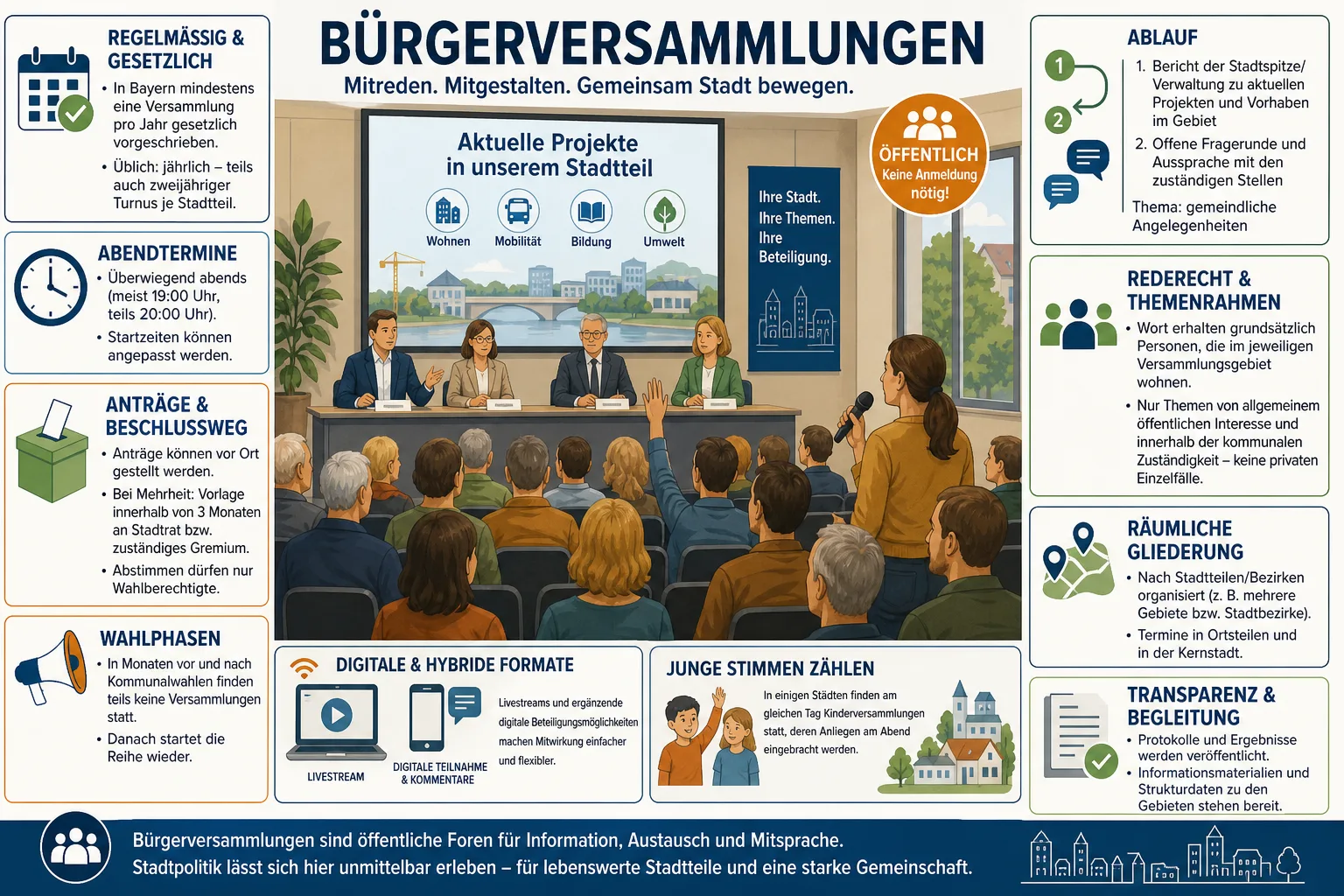
The special feature: You can ask questions in the same room where the administration and city leadership provide information. If a concern affects many people and falls under the city's responsibility, it can become a motion in the assembly, which is then dealt with by the responsible committees.
Finding the Next Dates: How to Keep Track of Citizens' Assemblies in Koblenz
To make sure you don't miss any upcoming citizens' assembly, these steps will help you:
- Check official announcements: Regularly check the City of Koblenz website in the coming weeks for announcements, dates, and event notifications.
- Use official gazettes & local notices: Pay attention to public notices and postings in your district (e.g., in community centers, public institutions, or event venues).
- Set calendar reminders: As soon as a date is published, enter it directly. Citizens' assemblies are often held in the early evening so as many people as possible can attend.
If you are unsure which assembly is for your residential area, refer to the announced spatial allocation (district/assembly area) in the respective invitation.
What Will Likely Happen at the Next Citizens' Assembly (Process & Agenda)
Even though topics vary by district, you can typically expect the following process at an upcoming citizens' assembly:
- Opening & framework: The assembly leadership presents the process, speaking order, and planned agenda.
- Current projects: Administration and, if applicable, project managers provide an overview of ongoing and upcoming measures in the district (e.g., planning, construction projects, traffic, municipal services).
- Questions & discussion: You can ask questions, give feedback, and name topics that are important for your district from your perspective.
- Motions & votes: If a concern is suitable (general interest, municipal responsibility), it can be formulated as a motion and put to a vote. If approved, it is then forwarded to the responsible offices or committees.
- Summary & next steps: At the end, it is usually recorded which points are documented, what the next steps are, and where results can be read later.
To attend with a clear goal, a brief preparation is worthwhile: Formulate your concern as a concrete question or actionable proposal (who/what/where/when, why important, what alternative).
Right to Speak, Participation, Motions: How You Can Actively Participate Next Time
1) Participation: Attend, Listen, Identify Topics
At the next citizens' assembly, you can first get your bearings: Which projects are announced? Which responsibilities are mentioned? Who is the contact person? Even as a listener, you get a very direct insight into how city politics is concretely organized in the district.
2) Speaking Contribution: Brief, Clear, Solution-Oriented
If you speak up, a structured statement increases the chance that your point will be taken up:
- Describe the problem precisely (location, time, affected group)
- Name the impact (safety, noise, accessibility, barrier-free access)
- Make a concrete suggestion (e.g., marking, lighting, speed, crossing, greening, signage)
- Ask about the next step (responsibility, review order, schedule, feedback)
3) Motion: From Concern to Actionable Order
If it becomes clear in the room that a topic affects many and falls under the city's responsibility, your proposal can be formulated as a motion so that it can later be reviewed by the administration and committees. Make sure the motion:
- has a clear addressee (responsible office/committee),
- demands a concrete measure,
- establishes a spatial reference (street/square/section),
- and names a goal (e.g., increase safety, improve quality of stay).
Hybrid or Digital Participation: What You Should Consider for Upcoming Formats
For upcoming dates, there may be digital elements in addition to in-person attendance (e.g., livestream, digital question option, or hybrid participation). Whether and how this is offered is stated in the respective invitation.
If you want to participate online, check in advance:
- whether registration is required,
- by when questions can be submitted,
- and whether you also have speaking rights online or can only watch.
For the most effective participation: Use digital participation mainly to stay informed and to submit questions; for complex concerns, in-person attendance (if possible) can facilitate direct clarification.
After the Event: How to Track What Happens to Points and Motions
The most important part begins after the upcoming citizens' assembly: the follow-up. Pay attention to where minutes, summaries of results, or notes on further handling are published. If contact options are given, use them specifically:
- Ask follow-up questions if responsibilities are unclear
- Note file numbers/subject (if mentioned) to follow up clearly later
- Keep an eye on follow-up dates if a topic is further discussed in committees or the city council
This turns a single evening into a plannable participation process.
Conclusion: The Next Citizens' Assemblies Are Your Direct Access to Koblenz City Politics
If you want to actively help shape Koblenz in the coming months, citizens' assemblies are one of the most accessible formats: You get up-to-date information, can ask questions, make positions from your district visible, and formulate concerns so that they find their way into the responsible committees.
You get the most out of it if you (1) find the next date early, (2) prepare your concern concretely, and (3) follow up after the assembly to see how things progress.