Civic Participation & Urban Development in Koblenz
Civic Participation & Urban Development in Koblenz: How You Can Help Shape Upcoming Projects
What could Koblenz look like in the coming years if citizens are not only informed but involved in planning from an early stage? This very question is becoming increasingly practical in upcoming neighborhood processes, downtown topics, and climate adaptation measures: participation is becoming the interface between everyday experience on site and professional planning.
This article explains which participation methods are typically used in Koblenz, which topics will be particularly relevant in the upcoming planning and implementation phases (urban greenery, mobility, climate resilience, mixed use), and how you can contribute effectively – without technical jargon, but with an eye on the formal rules.
Why Civic Participation Will Be Crucial for Koblenz in the Future
Urban development will become more complex in the coming years: heat days, heavy rainfall, space pressure, housing needs, usage conflicts in the city center, and the desire for attractive public spaces must all be addressed simultaneously. Civic participation is not an “extra,” but a tool to make decisions understandable and to systematically feed local knowledge into planning.
Especially in heterogeneous neighborhoods – with different daily routines, age groups, languages, working hours, and living situations – the quality of participation determines whether measures are later accepted, used, and maintained in the long term. Well-executed participation also provides insights that maps and models alone can hardly depict: Where are shade and seating missing? Which paths are actually used? Where do conflicts arise between cyclists, delivery traffic, and pedestrians? Which places feel unsafe – and why?
Ways to Participate: Formal, Informal, Digital, and On Site
1) Formal Participation (Legally Regulated)
When development plans or comparable procedures are being prepared, the Building Code (BauGB) provides for participation steps. This is important for citizens because objections and suggestions must be documented, reviewed, and weighed during these phases. This does not automatically make contributions “enforceable,” but they are treated as legally binding.
- Typical benefit: You can address specific regulations, uses, traffic solutions, noise issues, green space proportions, and climatic aspects.
- Typical challenge: Documents are technical; deadlines are binding. It pays to structure your contributions clearly.
2) Informal Participation (Early, Low-Threshold, Practical)
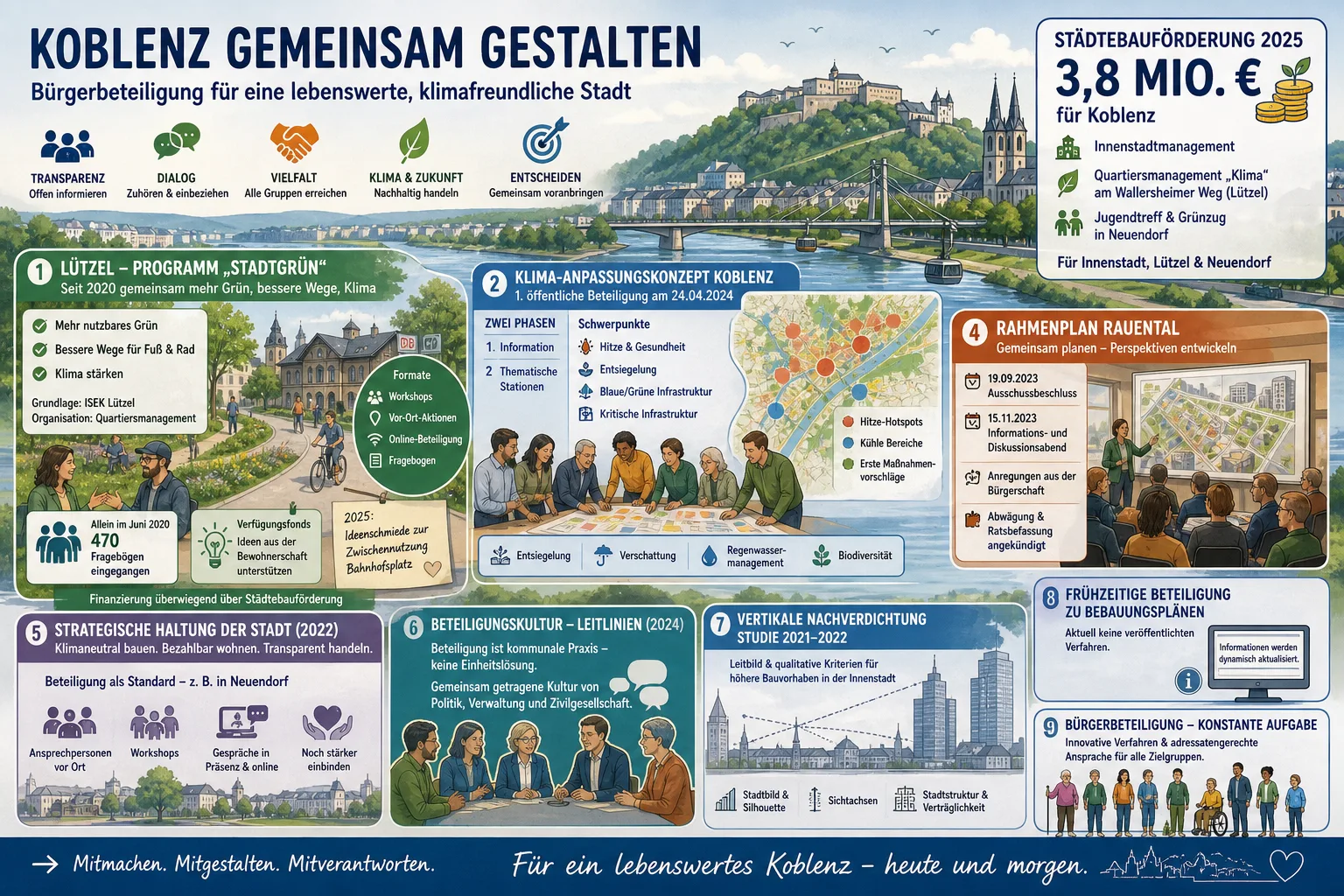
In addition to formal participation, Koblenz (like many cities) uses informal formats to clarify issues earlier: neighborhood walks, workshops, dialogue stands in squares, workshops with schools/clubs, or moderated idea workshops. Informal participation often determines which options even make it into professional elaboration.
3) Digital Participation
Online dialogues, map tools, and surveys help to collect input across the board and reach people who cannot attend evening appointments. Digital participation is particularly effective when it transparently reflects results: What was mentioned frequently? What is feasible? What is postponed – and why?
4) Neighborhood Management as a “Translator” Between Everyday Life and Planning
Where neighborhood management is used, it bundles information, organizes formats, mediates between groups, and keeps participation going over longer periods. For the coming years, this continuous approach is crucial because urban development is rarely decided in a single meeting, but in many small deliberations.
What Will Be Especially Important Next in Koblenz
Urban Greenery & Quality of Stay: More Shade, More Usability, Less Heat
In future neighborhood and open space projects, urban greenery will no longer be seen as mere “decoration,” but as infrastructure: trees and green spaces reduce heat stress, improve quality of stay, and – if properly planned – can retain rainwater on site. In participation processes, practical, everyday suggestions are especially needed:
- Which paths are particularly hot in summer (lack of shade, reflective facades, heavy sealing)?
- Where are seating, drinking facilities, or safe crossings missing?
- Which areas are suitable for unsealing, tree planting, or small islands for staying?
Climate Adaptation: Dealing with Heat and Heavy Rain as a Joint Urban Project
In upcoming concept and implementation phases, Koblenz will focus more on “blue and green infrastructure”: managing rainwater locally (instead of just draining it), reducing sealing, connecting green spaces, and mitigating heat hotspots. Participation is especially valuable here because residents know exactly where water stands after heavy rain, which underpasses are problematic, or which stops become burdensome without shade.
City Center: Mixed Use, Routes, Delivery Traffic, and Quality of Spaces
A future-proof city center is not created by individual measures alone, but by coordinated priorities: good accessibility on foot and by bike, appropriate solutions for delivery and commercial traffic, attractive squares, cultural and leisure offerings, and a climate and heat protection concept for densely built areas. Future participation rounds typically revolve around questions such as:
- Which squares should become quieter, greener, or more versatile?
- How can pedestrian and bike paths be made safer without ignoring necessary traffic?
- Which uses are missing (e.g., places to stay, public seating areas, weather-protected meeting points)?
Framework Plans & Area Development: Creating Clarity Early, Avoiding Conflicts
Where major changes are pending (e.g., in commercially dominated areas or on key axes), framework plans are an important tool for setting guidelines before individual projects arrive. For citizens, the best time to influence is usually before detailed planning: when goals, traffic concepts, noise protection principles, and green structures are still open for discussion.
Building Culture & Densification: Quality Instead of Just “More Space”
If densification is to take place in Koblenz in the future, building culture will become more important: building impact, city silhouette, sightlines, street space quality, wind and shade effects, and the integration of historical structures. Participation is most effective here when it demands concrete quality criteria (e.g., comprehensible design guidelines, greening, ground floor uses, open space proportions) rather than just being generally “for” or “against.”
How to Prepare Your Contribution (So It Carries Weight)
-
Describe a specific problem at a specific location. Instead of “It’s too hot,” better: “At stop X, there is no shade; between 12 and 5 pm, the waiting area is fully in the sun.”
-
Add a feasible idea. For example: additional trees, shading elements, unsealing, safe crossing, seating, rainwater swale, greening of side areas.
-
Consider goal conflicts. If you propose a redistribution of street space, also state how delivery zones, accessibility, or emergency routes can be taken into account.
-
Use maps, photos, and short measurement/observation notes. A photo or sketch makes objections more verifiable. Even short notes like “water regularly stands here after heavy rain” help the administration set priorities.
-
Stick to verifiable statements. Avoid assumptions; instead, state observations, time periods, and impacts.
If you want to participate, check the official information channels of the City of Koblenz in the future (announcements of procedures, appointments, online dialogues, and documents) and pay particular attention to early phases: at that stage, options are still flexible.
Sources & References
- Building Code (BauGB) – Laws Online — Regulations on public participation in land-use planning (accessed 2026-06-24)
- Urban Development Funding (Federal/State) — Goals, programs, and basic principles including integrated approaches (accessed 2026-06-24)
- Federal Environment Agency: Adaptation to Climate Change — Basics on heat, heavy rain, adaptation measures in urban areas (accessed 2026-06-24)
- German Weather Service (DWD): Climate Atlas — Background on climatic developments and extreme events (accessed 2026-06-24)
- City of Koblenz: Official Website — Announcements, procedures, and information on municipal projects and participation formats (accessed 2026-06-24)