Film Festival in Koblenz: Festivals, KUFA & Community Cinema
Film Festivals & Short Film Evenings in Koblenz: Where Films Connect People
What does it feel like when an entire hall in Koblenz holds its breath at the same time – just because of a single scene? And what happens when, after the credits roll, not everyone rushes home, but instead stays to talk with each other? This is exactly where the special magic of film festivals, community cinema, and curated short film formats unfolds.
This article is intended as a reliable guide for upcoming film events in Koblenz: Which formats you can typically expect in the city, which venues are particularly important for them – and how you can reliably find future dates without relying on hearsay.
Why Koblenz Works So Well for Film Evenings
Koblenz brings together several factors that make film events especially vibrant: central cultural venues, an active club scene, proximity to universities, and a city society where exchanges about art and everyday topics quickly spark conversation. That’s why series that go beyond the regular cinema program keep emerging here – with audience discussions, thematic focuses, and low-threshold entry points.
- Places with a spirit of encounter: Cultural centers and cinemas that not only allow for exchange but actively plan for it.
- Curatorial diversity: Thematic focuses (e.g., intercultural, intergenerational, socio-political) that enable new perspectives.
- Participatory structures: Initiatives, clubs, and university contexts that translate program ideas into concrete evenings.
Format 1: A Film Festival with Curated Program and Audience Discussions
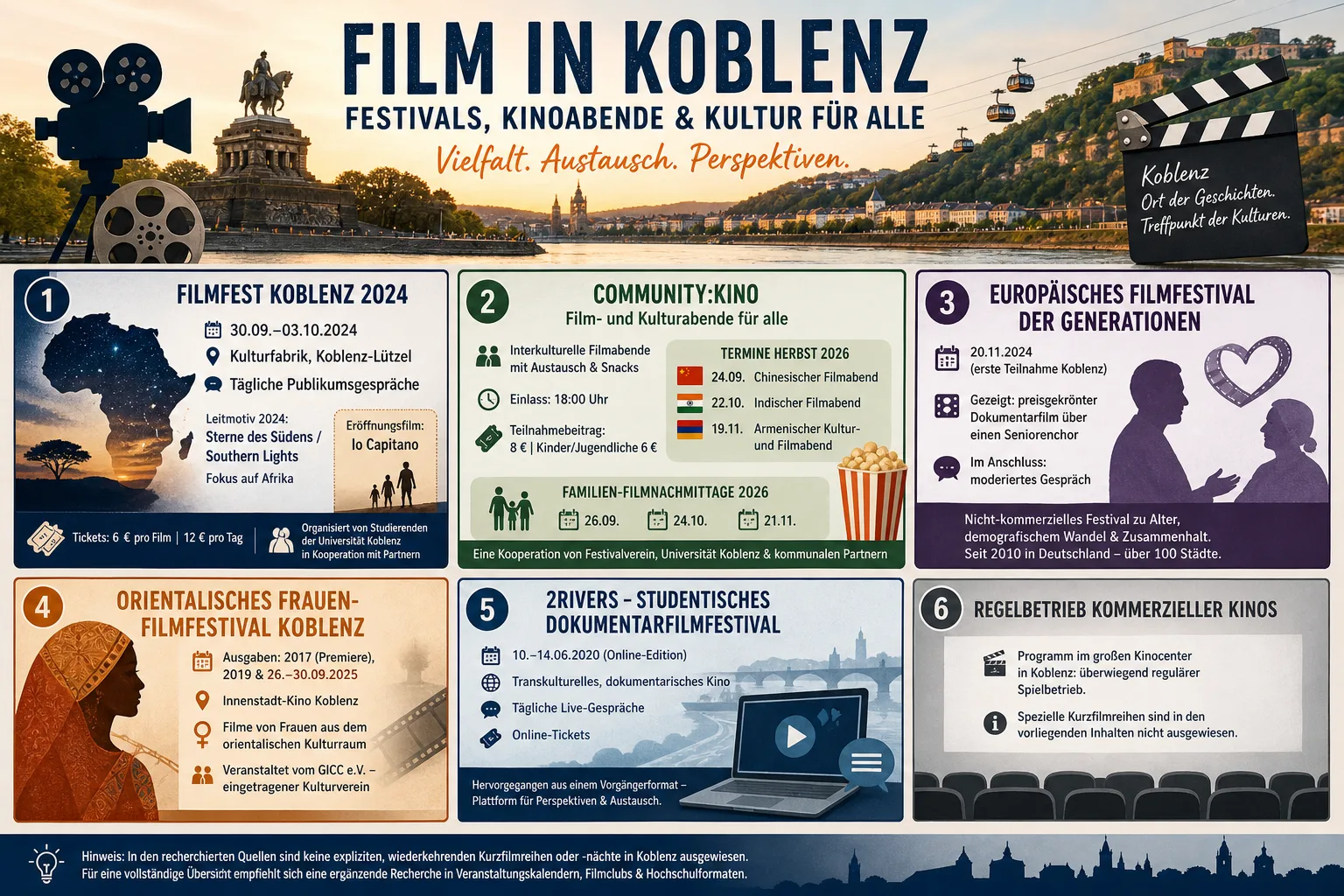
A central festival format in Koblenz is a multi-day, curated film festival that takes place at a fixed venue (often in a cultural context). Characteristic of such festivals is that the program does not work on the principle of a “start time list,” but instead operates with a clear thematic framework – for example, with a geographic focus, a social topic, or a question of film aesthetics.
What You Can Typically Expect at Upcoming Editions
- Curated line-up: Feature and documentary films that are deliberately related to each other.
- Moderated discussions: Q&As, introductions, or panels that contextualize what’s been seen and open up spaces for discussion.
- Low-threshold access: Often with reduced prices or formats that also appeal to first-time visitors.
If you are interested in upcoming festival editions, the most important practice is: Check dates exclusively via the official channels of the venues and organizers (see section “How to Reliably Find Future Dates”).
Format 2: Community Cinema – Intercultural, Approachable, Together
Another strong format for the future is community-based film and culture evenings. Here, the focus is not only on the film, but also on the setting: arriving, talking with each other, sharing perspectives. Such evenings are often co-designed by local initiatives, communities, or cultural teams and deliberately rely on an open atmosphere.
How to Recognize Community Cinema
- Co-creation: People from the respective community shape the selection, moderation, and context.
- Accompanying program: Conversation, music, short inputs, or cultural elements that contextualize the film.
- Encounter as a goal: The exchange after the credits is often a planned program point – not “optional.”
For Koblenz, this format means above all one thing for the future: Film becomes a bridge between people who otherwise rarely meet in everyday life – without the event feeling didactic.
Format 3: Thematic Festivals – Making Voices Visible
For upcoming seasons, theme-focused festivals are also particularly relevant – for example, series that specifically highlight the perspectives of filmmakers who are less visible in mainstream cinema (e.g., women as directors in certain regions, diasporic narratives, or social transformation processes).
Such festivals work best when they combine two things:
- Film selection with attitude: A clear curatorial line instead of as much as possible of everything.
- Context instead of commentary: Conversations with guests, experts, or moderated discussions that leave room for different viewpoints.
If you want to attend such events, it’s worth not only reading cinema programs, but also subscribing to cultural calendars, club channels, and newsletters from venues.
Format 4: Generational and Dialogue Evenings (Doc Film + Discussion)
Documentary films followed by a discussion are particularly suitable for intergenerational evenings – for example, on topics such as demographic change, care, neighborhood, life plans, or social cohesion. Such evenings are often non-commercial and focus on exchanges that are often neglected in everyday life.
Typical Building Blocks for Upcoming Dates
- A selected film as a conversation starter (instead of “cinema as usual”).
- Moderation for structure – so that many voices are heard.
- Local networking (e.g., initiatives, educational providers, social work) that can translate discussions into options for action.
Short Film in Koblenz: How to Really Find Upcoming Short Film Evenings
Short film formats are often implemented in cities like Koblenz as thematic blocks, supporting films, or festival specials – less as a permanent weekly series. For the future, this means: If you are specifically looking for short film evenings, you should not only check “cinema schedules,” but pay particular attention to special events.
Practical Search Strategy (for the Coming Months)
- Venue websites: Filter programs/calendars for “special,” “festival,” “short film,” “screening,” “film series.”
- City/region cultural calendar: Many special dates are announced there earlier than on ticket portals.
- Newsletter & social media: Short-term collaborations are often communicated there first.
- University and initiative environment: Film clubs, lecture series, student cultural formats, and collaborations often announce screenings separately.
This approach is the most reliable because it relies on official announcements and at the same time makes smaller, temporary formats visible.
Planning & Attendance: How to Make the Next Film Evening in Koblenz Really Great
- Arrive early: For discussion formats, it’s worth arriving before the film starts – the “before” is often part of the concept.
- Bring questions: Audience discussions thrive on concrete observations (characters, perspectives, visual language, context).
- Respectful conversation culture: Intercultural or biographical topics benefit from “I” perspectives (“I noticed…”) instead of blanket judgments.
- Check accessibility: If you rely on certain access (subtitles, wheelchair spaces), it’s worth checking the event info in advance.
Outlook: Where Film Culture in Koblenz Can Develop
For the coming years, it is particularly likely that film events in Koblenz will continue to gain importance if they combine three principles: clear curation, encounter, and reliable communication (dates, ticketing, accessibility). Especially where the audience not only consumes but also thinks along and participates, a screening becomes a real city experience.
Whether it’s a large festival, an intercultural community evening, or a moderated documentary film dialogue: Koblenz offers the right spaces for this – and above all, the right audience.