Cultural Education & Societal Discourse in Koblenz
Cultural Education & Societal Discourse in Koblenz: What is Planned for the Coming Years
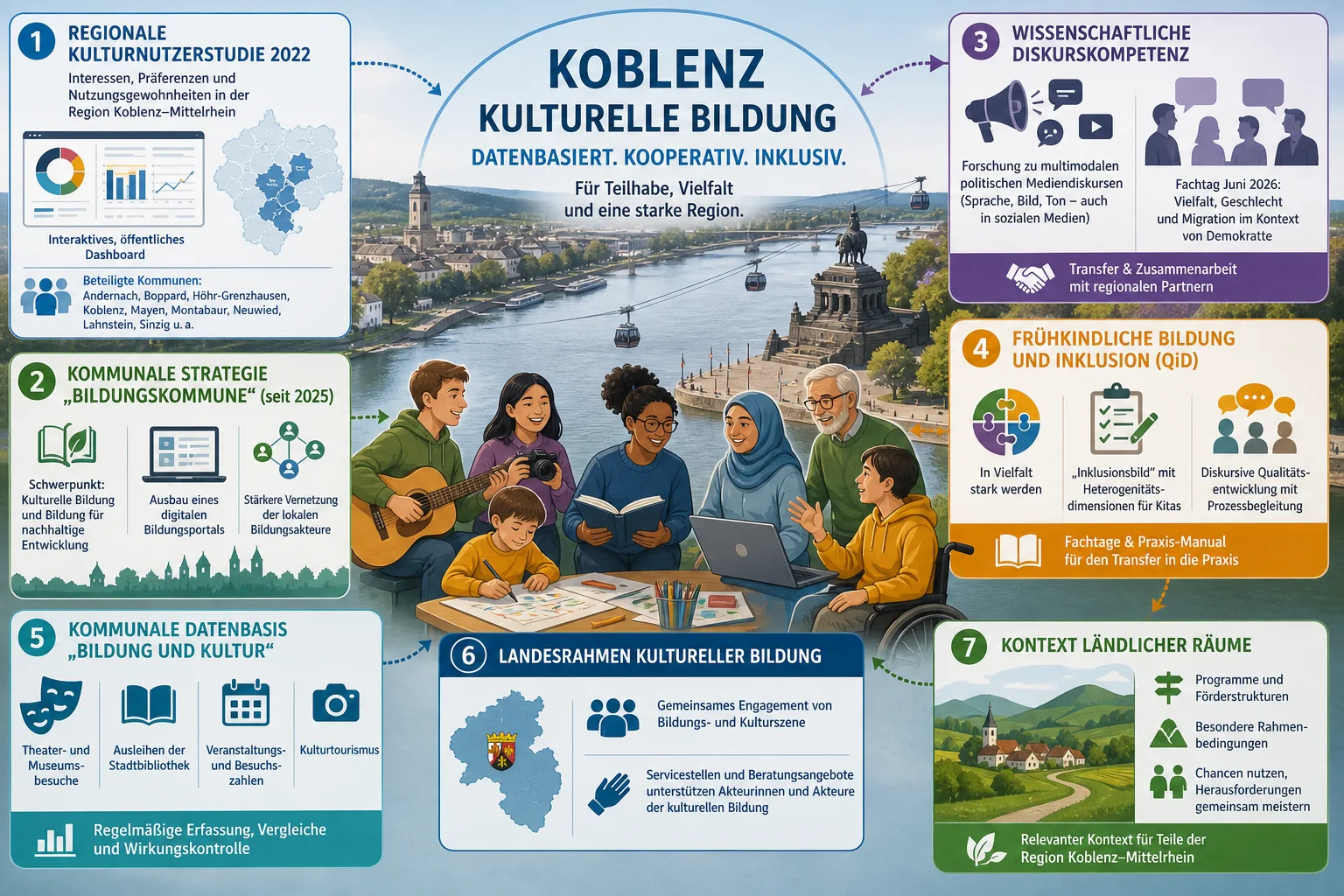
Koblenz wants to more closely intertwine cultural education and societal discourse in the coming years: with more transparent data, better networking of offerings, and more space for democratic negotiation processes – from early education to university level.
Context: Why “Culture + Discourse” Will Belong Together Even More in the Future
When cities not only promote culture but also organize it to be accessible, verifiable, and capable of learning, more than just an event program emerges: an infrastructure for participation is created. In Koblenz, initiatives are emerging for the coming years that aim precisely at this: making offerings more visible, understanding usage more systematically, and at the same time creating spaces where diversity, belonging, and democratic debate culture are practically exercised.
This outlook focuses exclusively on future developments and how they can be designed sensibly, fairly, and transparently.
Koblenz as an Educational Municipality: Culture as a Task for the Future
In the coming years, Koblenz aims to further expand its role as an educational municipality. At the center is the idea of a networked educational landscape, in which cultural education and education for sustainable development are not seen as an add-on, but as the foundation of municipal future viability.
What is Planned for This
- More Visibility for Offerings: Educational and cultural offerings from daycares, schools, cultural institutions, associations, and universities should become easier to find and compare, so that families, newcomers, and visitors can quickly discover suitable formats.
- Better Cooperation Instead of Isolated Solutions: Projects should build on each other more (e.g., transitions from daycare to school or from school projects to cultural venues), so that participation does not depend on chance.
- Lower Barriers to Access: Future formats should take different life situations more into account (time slots, costs, language, mobility, digital access).
This makes cultural education a tool to strengthen cohesion: not through “uniform culture,” but through more opportunities to express oneself, listen, and tolerate differences.
Transparency Through Data: How Cultural Policy Can Become More Measurable in the Future
For the coming years, a development is visible in many municipalities (and increasingly also regionally): Culture is not only described programmatically, but observed with clear indicators. In Koblenz, data bases can also play a greater role in the future to make debates more objective – without reducing culture to mere numbers.
Which Data Will Be Particularly Helpful in the Future
- Usage Data (e.g., visits, borrowings, participation in workshops)
- Accessibility & Access (e.g., times, locations, accessibility, digital offerings)
- Participation Perspective (who is reached – and who is not?)
For a data-based approach to remain trustworthy, future publications (e.g., in a dashboard) should clearly explain:
- which data are collected and which are not,
- what uncertainties or distortions exist (e.g., self-selection in surveys),
- how data protection and anonymization are implemented.
This can create transparency that does not control, but provides orientation: for cultural providers, administration, politics, and the public.
Early Childhood Education: Discourse Skills Begin Before School
A future-oriented approach to cultural education and democratic learning starts early: in daycares, in teams, in cooperation with parents. In the coming years, models that understand quality development as discourse will gain importance: not as a rigid checklist, but as a reflective practice that continues to develop.
What Can Be Effective in Daycares in the Future
- A Broad Understanding of Diversity: Children experience differences (language, family, religion/worldview, social status, gender, abilities). Good practice recognizes this diversity without stigmatizing.
- Team Reflection as Standard: Regular, moderated reflection can help identify blind spots (e.g., expectations of “normal” behavior or language).
- Parents as Partners: Transparent communication about educational goals reduces misunderstandings and strengthens trust.
If children learn early to express their perspective, listen, and resolve conflicts fairly, this is a long-term investment in democratic culture – and thus also in the societal discourse of a city.
University Location: Media Literacy and Discourse as Transfer into the City
In the coming years, the university location Koblenz can play an even more visible role in classifying societal debates – especially where political communication takes place today: in digital and multimodal media (text, image, sound, video).
Which Formats Will Be Particularly Useful in the Future
- Media Literacy Workshops (e.g., recognizing manipulation, classifying sources, dealing with emotion in debates)
- Public Lectures and Dialogue Formats that translate research in an understandable way
- Cooperations with Schools, Cultural Venues, and Civil Society in which students work in a practical way
This is relevant for a city like Koblenz because discourses about diversity, migration, equality, or social justice will continue to gain importance in the future. Scientific transfer can help ensure that discussions are conducted more informed and less polarizing.
Region Koblenz–Mittelrhein: Reconnecting Cultural Education Between City and Countryside
For the next years, the city-country interconnection remains a key task: People live in different municipalities, work or study in Koblenz, and cultural participation often depends on mobility, time, and cost.
Approaches That Can Build Bridges in the Future
- Mobile and Decentralized Formats (e.g., pop-up workshops, cooperations with schools, associations, libraries)
- Combination of Analog and Digital (on-site experience plus digital preparation and follow-up)
- Regional Cooperations so that offerings do not compete but complement each other
If regional actors define common goals and systematically exchange experiences, cultural education can reach the region more evenly in the coming years.
Outlook: What Will Be Especially Important by 2030
For Koblenz, four guiding principles can be formulated for the coming years that can practically bring together cultural education and societal discourse:
- Participation as a Benchmark: Not just “more programs,” but more access for people who have so far been reached less often.
- Transparency Without Technocracy: Use data to manage better – but continue to justify, discuss, and democratically weigh decisions.
- Start Early: Strengthen daycares and schools as places where diversity is experienced as normal and language for conflict is learned.
- Protect Spaces for Discourse: Design events and educational formats so that different perspectives can be safely expressed – with clear rules against discrimination.
If these guiding principles are consistently implemented, Koblenz can show in the coming years how a city not only offers culture, but further develops it as a democratic infrastructure.