Time Travel through Koblenz in Old Photographs
Time Travel through Koblenz: Old Photos, Stories & People – How You Will Experience the City in the Future with Photo Comparisons
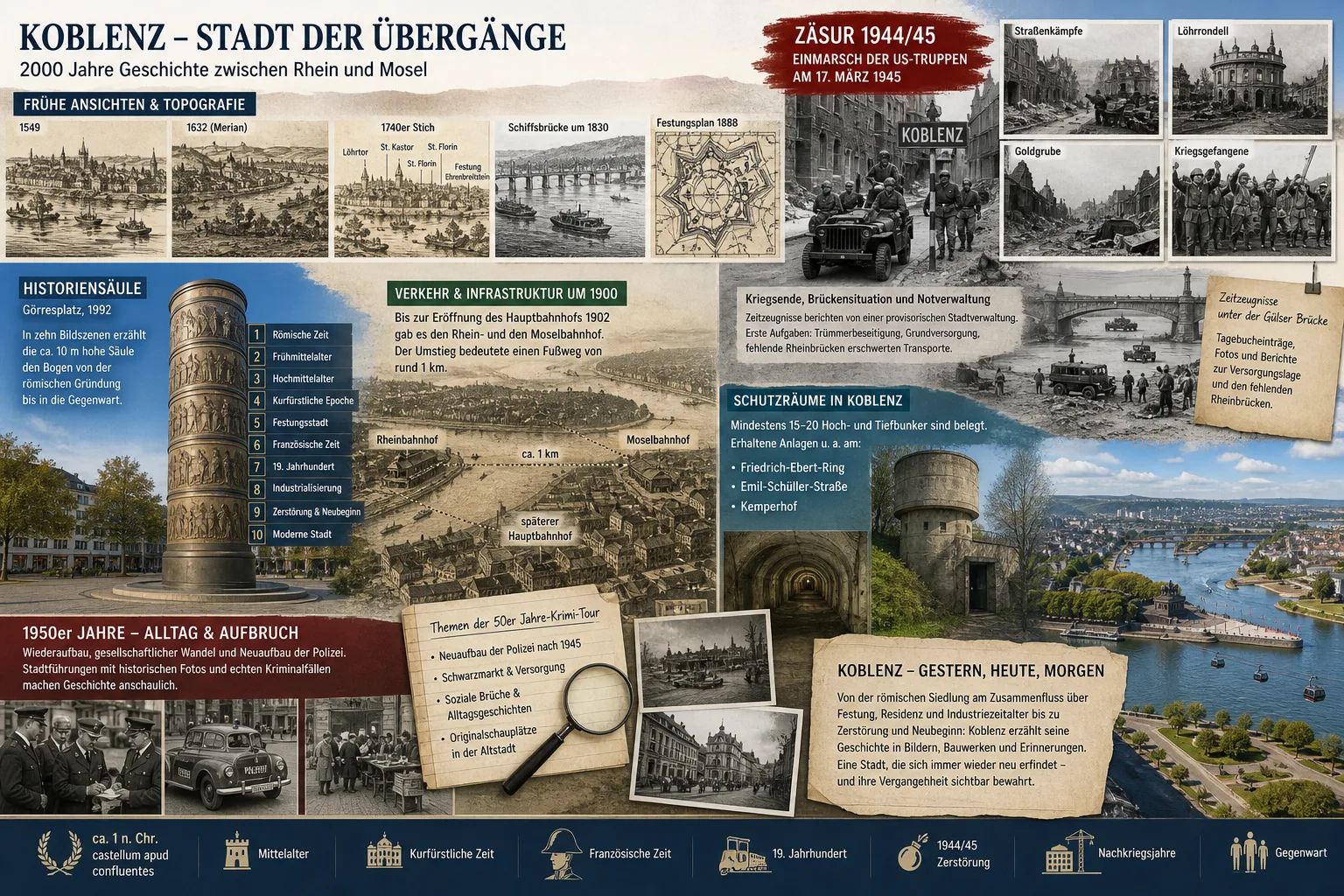
This guide shows how you can use historical image sources (photos, engravings, maps, aerial images) in Koblenz for your own walks, photo comparisons, and thematic visits in the coming months and years – respectfully, critically, and suitable for everyday use.
Why Photo Comparisons Tell Koblenz Anew
When you walk through Koblenz in the future, you can overlay the present with historical photographs, engravings, and maps: not as a "finished" history, but as an invitation to observe. Photo comparisons are particularly effective because they relate everyday places (alleys, squares, waterfronts) to what previous generations saw, documented, or remembered there.
For your own time travel, the key is: you do not need to be an expert. With reliable sources, a simple method, and some context, you can derive concrete questions from images that will deepen every city encounter in the future – for example: Why is this axis so wide? Why is there a break in the facade line here? What remained constant, what changed?
Preparation: How to Find and Check Image Sources
1) Reliable Points of Contact (online & on site)
- City/Municipal Archives and Museums: Pay attention to metadata (date, photographer, collection, signature) and usage rights.
- State and Federal Portals: For digital collections, preview images, and often also license information.
- Academic Libraries: Often with cartographic collections, newspapers, and regional history literature.
2) Minimal Source Check to Reduce Errors in the Future
- Dating: Is the image clearly dated or only estimated? Prefer sources with traceable dating.
- Location Accuracy: Check whether the location is specified exactly (street/square) or just generally "Koblenz".
- Context: Is there an image description, accompanying text, inventory note, or collection context?
- Editing: Note that reproductions (postcards, reprints, digitally sharpened scans) can alter details.
- Rights: Only plan publications (blog/Instagram/print) with clear license or permission.
3) Your Personal "Time Travel Folder" (practical, not technical)
For future walks, a small selection per station is sufficient: one image (old), a short note (source, dating, viewing direction), and a guiding question. The less material you take with you, the easier it is to focus on the place itself.
Three Future Route Ideas for Your Time Travel
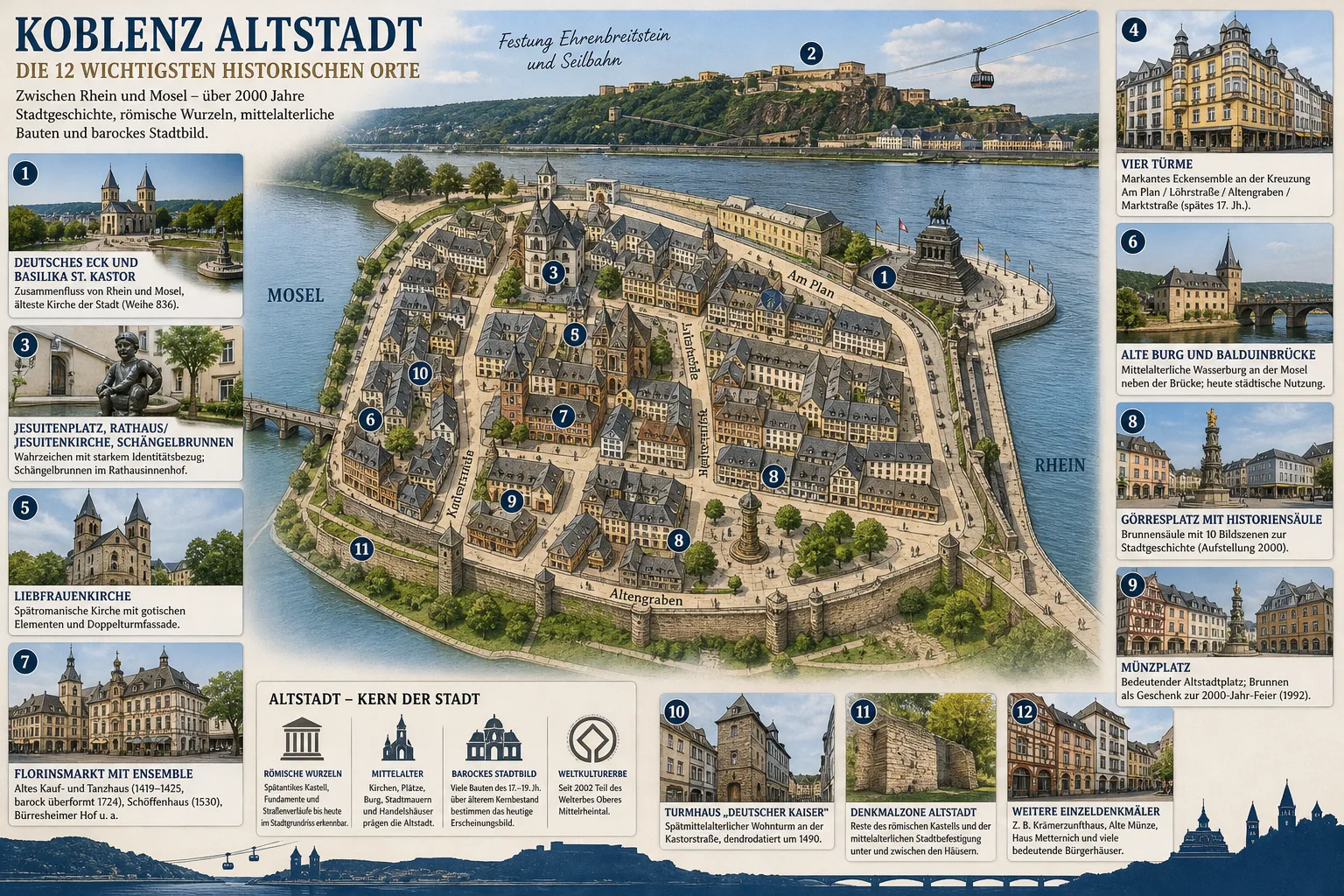
Route A: Old Town – Short Distances, Many Comparison Points
This route is suitable for future first-time visits and short time windows. It focuses on sightlines and squares where image sources are often available and changes can be easily recognized.
- Kastor Church: Ideal for photo comparisons with older city views, as the location is easy to find and perspectives are often repeatable.
- Florinsmarkt: Well suited for social motifs (market/square life) and for observing facade lines and spatial edges.
- Görresplatz (History Column): As a "reading station": Use the column as a starting point to then select image sources with similar motifs.
Route B: Rhine & Moselle – Banks, Crossings, Distant Views
This route works particularly well if you want to understand panoramas, riverbank design, and sightlines in the future. It is also suitable for comparing aerial images (if available) with today's sightlines.
- Deutsches Eck: For future comparisons, choose identical viewpoints (railings, plateau edges) to make changes in viewing direction and use visible.
- Riverside Promenades: Pay attention to elevation edges, stairs, railing shapes – they help to rediscover old perspectives.
Route C: Fortress & Counterview – "City from Above" Without a Drone
If you want to grasp the city structure at a glance in the future, plan a visit to a high vantage point. The added value comes from the comparison: Which districts appear coherent, where are breaks, which paths dominate?
- Ehrenbreitstein Fortress: Suitable for panorama comparisons and for understanding topography, river courses, and sightlines.
On Site: How to Achieve "Then/Now" Moments
Finding the Standpoint (in 3 Steps)
- Clarify Viewing Direction: Identify a fixed point in the historical image (church tower, street bend, riverbank).
- Estimate Height: Was the photo taken at eye level, from stairs, a window, or an elevated platform?
- Use Lines: Street edges, roof lines, and vanishing points help to pinpoint the location more precisely than "beautiful" motifs.
Documenting Photo Comparisons Without Disturbing the Surroundings
- Briefly Note: Date of your visit, weather/light, exact position (e.g., "at the corner of X/Y, 3 steps back").
- Photograph Respectfully: If people are recognizable, observe data protection and personality rights in the future.
- Add Context: A sentence about the source of the historical image increases traceability (e.g., archive/portal, signature/link).
Ethics & Sensitivity: Dealing with Distressing Motifs
Many historical collections will also contain motifs in the future that show violence, destruction, hardship, or persecution. If you integrate such images into your time travel, a clear, respectful attitude helps:
- No Dramatization: Describe what the image shows and what is unclear – without speculation.
- Context Before Effect: State the source, dating (if confirmed), and the purpose of the image (if documented).
- Consideration in Public Spaces: If you are in groups, address sensitive topics in quiet places and avoid "showcasing" at busy spots.
- Further Resources: In the future, refer to archives, museums, and educational offers that provide context.
For Families, Schools, and Groups: Formats That Work
Mini-Challenge (30–60 Minutes)
- In the future, choose 3 stations (e.g., Kastor Church, Florinsmarkt, Deutsches Eck).
- Per station: 1 image + 1 question ("What has stayed the same?" / "What is new?").
- At the end: Each person names one observation that would not have been noticed without the image.
Project Idea (Multi-Week)
For future school or club projects, a "source trail" is suitable: one group collects image sources (with proper source citation), another reconstructs standpoints, a third writes short, verifiable captions. This creates a small, verifiable exhibition in the classroom or club room – without exaggeration and without unchecked claims.