Adult Education Center Koblenz: Courses, Workshops & Education
Adult Education Center, Workshops & Courses in Koblenz: How to Learn Something New Next Semester
Do you want to start a language in Koblenz, try out your creativity, or upgrade your digital skills for work? Then it’s worth taking a look at the upcoming course starts at the Adult Education Center (VHS): The program bundles compact workshops, multi-week course series, and online formats that can be easily combined with everyday life, work, and family.
Who this overview is for: for people in Koblenz and the surrounding area who want to select a course and register specifically within the next few months.
Education in Koblenz: The Adult Education Center as a Central Point of Contact
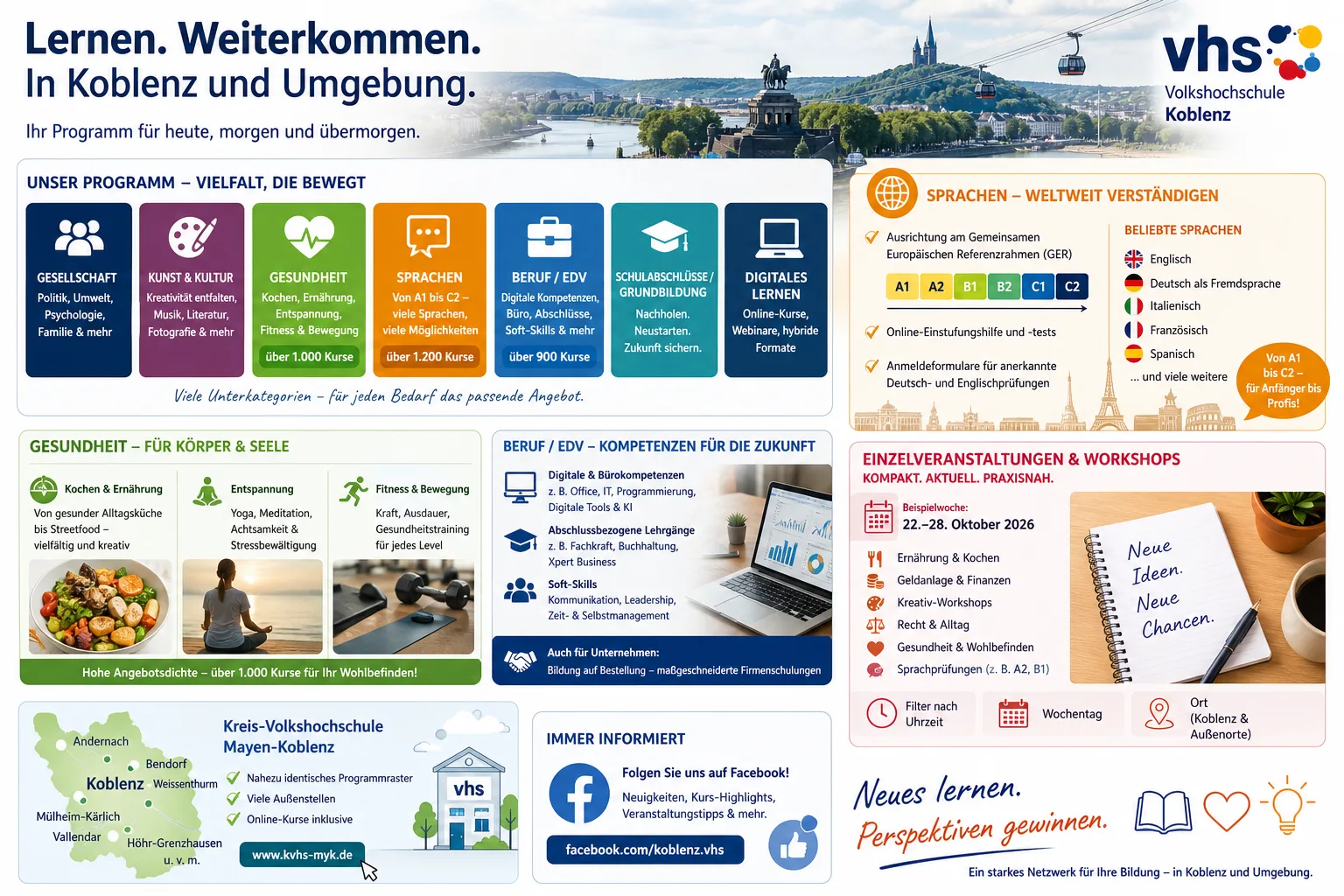
In the next program section of the VHS Koblenz, courses and events are typically bundled into clear subject areas. This structure helps you quickly filter what fits your goal:
- Society (e.g. politics, current issues, consumer knowledge)
- Art & Culture (e.g. drawing, painting, writing, photography)
- Health (e.g. exercise, relaxation, nutrition, cooking practice)
- Languages (levels according to CEFR, some with exams)
- Career & IT (digital skills, office organization, soft skills)
- School Qualifications & Basic Education (building and refreshing basic knowledge)
- Digital Learning (online and hybrid courses for flexible participation)
For your planning in the coming semester, it is especially important: In many areas there are different start times (ongoing entries, block weekends, evening courses). Those who decide early can secure the right time slots.
Courses for Body and Creativity: Health, Art & Culture
Health: practical, step-by-step, hands-on
In the next course cycle, health offerings are typically offered in Koblenz that aim for regular practice and easily implementable routines. Common formats are:
- Exercise courses (e.g. back, mobility, gentle training)
- Relaxation and stress management
- Nutrition and cooking offers (techniques, planning, cooking together)
If you have a specific goal (e.g. more exercise in everyday life or better time and stress management), it is worth looking for multi-week course series: They are often structured so that you can practice between sessions and get feedback in the course.
Art & Culture: learning by doing
For the upcoming program, creative courses are usually planned in Koblenz where you work directly hands-on—with materials, technique, and guidance. Particularly popular are often:
- Drawing and painting (basics to advanced)
- Creative writing and text work
- Photography workshops (shooting, image composition, selection)
- Craft and design techniques
An advantage of these formats: You can start without much "prior knowledge pressure" and make visible progress over several sessions—or you can choose a compact workshop as an introduction.
Learning Languages in Koblenz: Orientation with CEFR (A1–C2) and Plannable Course Starts
In the language area, course planning is usually based on the Common European Framework of Reference for Languages (CEFR). This means: The courses are sorted by levels from A1 to C2—a clear help if you are starting new or want to resume after a break.
For the upcoming period, several course options in common languages are often offered in Koblenz, for example:
- English (general, partly job-related)
- German as a Foreign/Second Language (depending on the offer also exam-oriented)
- French, Spanish, Italian (several levels, depending on demand)
So that you don’t “misplace” yourself, many VHS language programs work with placement aids (e.g. placement tests or counseling). For you as a participant, this has a direct benefit: You are more likely to end up in a course that challenges you without overwhelming you—and you can set realistic learning goals for the coming months.
Career, IT and Digital Further Education: Skills for the Next Steps
In the upcoming course starts in the area of Career & IT, the focus is typically on consolidating digital basics and making concrete work processes more efficient. Common topics are:
- Word processing and spreadsheets (practical)
- Presenting and structured data storage
- Digital collaboration and online tools
- Organizational and office skills
- Communication, time management, and appearance (soft skills)
If you are pursuing a clear goal—e.g. re-entry, job change, or a new area of responsibility—it is best to choose a format with multiple sessions and defined learning objectives. For companies in Koblenz, it may also be interesting that adult education centers often offer individual company training or needs-based formats (depending on the current program and capacities).
Workshops, Single Sessions and Online Formats: Plan Flexibly
For the next few months, two formats are particularly helpful if you have little time or just want to “try it out” first:
- Workshops (compact, often in the evenings or on weekends)
- Single events (one session, one topic, clear output)
Typical workshop topics that are often found in the upcoming program are practical cooking and nutrition topics, creative techniques, photography, consumer knowledge, as well as short learning and intensive formats.
Additionally, online and hybrid courses are often offered in the next course section. This can be advantageous if you live outside the city center, have irregular working hours, or want to reduce travel—without missing out on course structure and exchange.
How to Find the Right Course Now (and Stick With It)
- Set a goal: Is it about health, language, creativity, or professional skills?
- Choose the right format: Workshop (quick), course series (long-term), online/hybrid (flexible).
- Check level/start point: For languages, the CEFR level helps; for IT, look at “basics” vs. “advanced.”
- Plan time slots realistically: A fixed evening per week is often easier to stick to than “sometime.”
- Register directly and clarify materials: This way you can start relaxed when the course begins.
A good plan for the coming weeks is: Choose one skill you really want to improve (e.g. A2–>B1, more confident with spreadsheets, regular exercise) and set a manageable learning window for it. This increases the chance that a course start will become a real routine.