Michelangelo
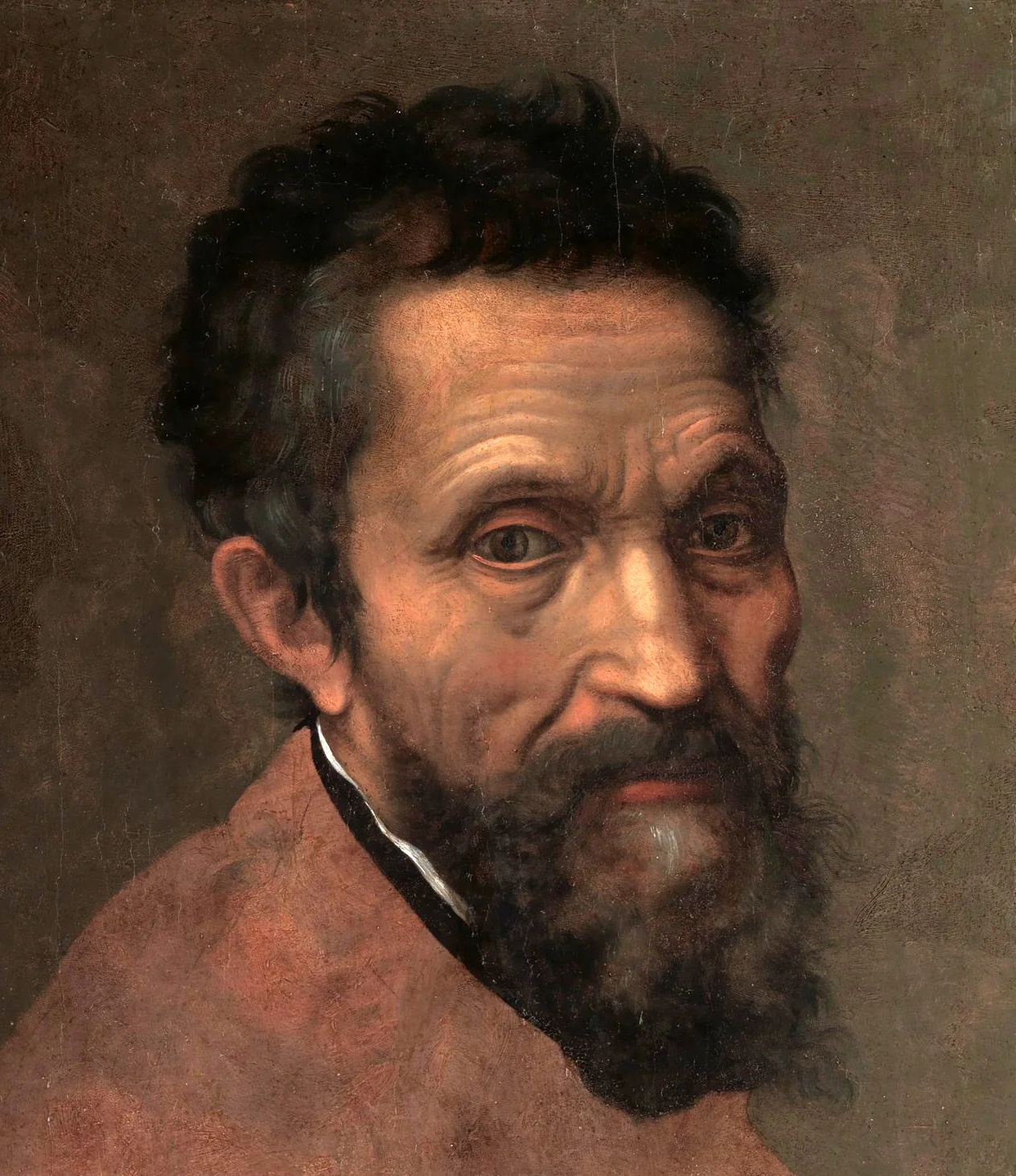
Image from Wikipedia
Image from Wikipedia
Michelangelo Buonarroti – The Master of the High Renaissance Who Redefined Art History
A Genius between Marble, Fresco, and Architecture
Michelangelo Buonarroti is among those artists whose name has long transcended art history, serving as a synonym for creative greatness. Born in Caprese in 1475 and passing away in Rome in 1564, the Italian worked as a painter, sculptor, architect, and poet, shaping the High Renaissance with an artistic force that resonates to this day. His contemporaries recognized him early on as a remarkable talent; Giorgio Vasari described him as the epitome of the genius artist as well as an ascetic worker of art. ([nationalgallery.org.uk](https://www.nationalgallery.org.uk/artists/Michelangelo?utm_source=openai))
Early Years: Florence as an Artistic Laboratory
Michelangelo grew up in a Florentine family that, while hinting at noble origins, did not possess great financial power. This tension between a consciousness of heritage, political tradition, and the real struggle for recognition profoundly shaped his self-understanding. He moved early on in the circles of the Medici and the Florentine art scene, where he received training that familiarized him with ancient sculpture, humanistic thought, and artisanal precision. ([museodelprado.es](https://www.museodelprado.es/en/the-collection/artist/michelangelo-michelangelo-buonarroti/dfbe65f6-9d4e-44f4-89f7-739512909435/load-more-entities-selector?utm_source=openai))
In Florence, the foundation of his later visual language developed: monumental bodies, inner tension, and extreme concentration on the human figure. This early phase, extending until 1494, shaped an artist who did not merely depict form but imbued it with intellectual energy. Michelangelo learned that art in his era was not merely decoration but a medium of power, religion, and cultural self-definition. ([museodelprado.es](https://www.museodelprado.es/en/the-collection/artist/michelangelo-michelangelo-buonarroti/dfbe65f6-9d4e-44f4-89f7-739512909435/load-more-entities-selector?utm_source=openai))
The Breakthrough: Rome and Initial Prominence
After a stay in Bologna and his first Roman phase from 1496 to 1501, Michelangelo entered a broader European sphere of influence. In Rome, he worked on commissions that soon earned him the reputation of an exceptional sculptor and elevated his career to a new level. His return to Florence in 1501 resulted in the creation of works that ultimately confirmed his status, most notably the monumental David, created between 1501 and 1504. ([museodelprado.es](https://www.museodelprado.es/en/the-collection/artist/michelangelo-michelangelo-buonarroti/dfbe65f6-9d4e-44f4-89f7-739512909435/load-more-entities-selector?utm_source=openai))
The David not only represents technical mastery in handling marble but also captures the psychological concentration of human energy. Michelangelo portrayed the figure not at the moment of victory, but in a state of tense expectation, as a focused force just before action. This is where his modernity lies: he made movement, will, and inner tension visible without surrendering the dignity of the classical form. ([museodelprado.es](https://www.museodelprado.es/en/the-collection/artist/michelangelo-michelangelo-buonarroti/dfbe65f6-9d4e-44f4-89f7-739512909435/load-more-entities-selector?utm_source=openai))
Roman Maturity: Monuments, Conflicts, and Unfinished Visions
Starting in 1505, Michelangelo began his long and tumultuous engagement with the tomb of Pope Julius II, a project that accompanied him for decades and underwent many transformations. This story illustrates an artist caught between commission, political reality, and personal vision. The tensions between ambition and execution only heightened his reputation as an uncompromising master. ([nationalgallery.org.uk](https://www.nationalgallery.org.uk/artists/Michelangelo?utm_source=openai))
His work in the Sistine Chapel also became a monumental achievement. The ceiling and later the Last Judgment in the altar area are among the most famous visual programs in Western art, showcasing Michelangelo as an artist who fused anatomy, theology, and dramatic composition into an overwhelming visual language. His figures seem to act not merely in space but to emerge from an inner moral and spiritual pressure. ([museivaticani.va](https://www.museivaticani.va/content/museivaticani/en/eventi-e-novita/notizie/2026/cappella-sistina-manutenzione-straordinaria-terminata.html?utm_source=openai))
Florence and Rome: A Life Between Two Cultural Poles
Michelangelo's biography unfolds in clearly recognizable stages: Florence, Bologna, Rome, back to Florence, and then again Rome, culminating in a long late phase in the Eternal City. Between 1515/16 and 1534, he lived in a Florentine period before spending the rest of his life almost exclusively in Rome. This movement between the two centers of the Renaissance intensified his status as a key figure in European art. ([museodelprado.es](https://www.museodelprado.es/en/the-collection/artist/michelangelo-michelangelo-buonarroti/dfbe65f6-9d4e-44f4-89f7-739512909435/load-more-entities-selector?utm_source=openai))
In Florence and Rome, his image as an artist of religious depth also took shape. Later works and drawings exhibit an even more concentrated, inward Michelangelo, grappling with questions of faith, aging, transience, and salvation. This last phase of life is often read as particularly intense: less spectacular outwardly, yet spiritually much more profound. ([mfa.org](https://www.mfa.org/exhibitions/michelangelo?utm_source=openai))
Work and Style: Anatomy, Disegno, and Emotional Monumentality
Michelangelo's art is based on an extraordinary combination of drawing, anatomy, and sculptural imagination. His drawings were not merely preliminary studies but standalone works that made the process of thinking in images visible. Particularly, his engagement with the human body, through anatomical studies, sharpened the tension between ideal and expression that makes his works unmistakable. ([metmuseum.org](https://www.metmuseum.org/exhibitions/listings/2017/michelangelo/exhibition-galleries?utm_source=openai))
Stylistically, Michelangelo represents the monumentalization of the figure. His bodies are not only physically present but energetically charged, as if they carry an excess of spiritual and emotional strength. This is precisely why his art so strongly influenced subsequent generations: it conveyed the Renaissance idea of humanity as the measure of all things into an almost superhuman form. ([galleriaaccademiafirenze.it](https://www.galleriaaccademiafirenze.it/en/?utm_source=openai))
Cultural Influence: The First Modern Artistic Genius
Michelangelo was perceived as an exceptional artist even during his lifetime, and his posthumous fame grew even more rapidly than that of many contemporaries. The notion of the autonomous, genius creator that would later decisively shape European art history crystallizes particularly clearly in his case. Museums and research institutions continue to honor him as a central figure in an understanding of art where spirit, craftsmanship, and invention are inextricably linked. ([nationalgallery.org.uk](https://www.nationalgallery.org.uk/artists/Michelangelo?utm_source=openai))
Even in the 21st century, Michelangelo remains a vibrant reference point. This is evidenced by current exhibitions, anniversary programs, and digital initiatives that reinterpret his body of work and place his key works from both Florence and Rome into new contexts. Particularly, the Galleria dell’Accademia in Florence and the surrounding Casa Buonarroti keep his memory alive not only as a monument but as an ongoing cultural engagement. ([galleriaaccademiafirenze.it](https://www.galleriaaccademiafirenze.it/en/?utm_source=openai))
Current Projects and Reception Today
For 2025 and 2026, several institutions point to ongoing or recently initiated Michelangelo projects, including the "Michelangelo 1475–2025" program in Florence and educational as well as digital formats that rediscover his influence. Conservation work on key pieces like the Last Judgment underscores that Michelangelo remains not only historically relevant but continues to be actively researched, preserved, and newly exhibited. ([galleriaaccademiafirenze.it](https://www.galleriaaccademiafirenze.it/en/?utm_source=openai))
The critical reception repeatedly highlights his artistic radicalism: the monumentality of form, the soulful intensity of his figures, the connection of technique and vision. Whether in exhibition texts, museum tours, or scholarly publications, Michelangelo emerges as an artist who not only exhausted the possibilities of the Renaissance but pushed them to their limits. This is why his work has remained a benchmark for ambition, standards, and artistic consistency for later centuries. ([metmuseum.org](https://www.metmuseum.org/exhibitions/listings/2017/michelangelo?utm_source=openai))
Conclusion: Why Michelangelo Continues to Fascinate Today
Michelangelo fascinates because he understood art as an existential form of thought. His visual world connects physical strength with spiritual depth, technical brilliance with emotional tension, and religious grandeur with profoundly human vulnerability. Those who engage with his art encounter not only the High Renaissance but one of the most formative creative characters in Western cultural history. ([nationalgallery.org.uk](https://www.nationalgallery.org.uk/artists/Michelangelo?utm_source=openai))
A visit to his most significant works – in Florence, Rome, or in the great museums of the world – remains an intense experience. Michelangelo is not an artist of mere observation, but one who poses lasting challenges: each figure, every drawing, each architectural decision compels us to redefine greatness. Anyone who wishes to experience art as a living force must confront Michelangelo. ([metmuseum.org](https://www.metmuseum.org/exhibitions/listings/2017/michelangelo?utm_source=openai))
Official Channels of Michelangelo:
- Instagram: no official profile found
- Facebook: no official profile found
- YouTube: no official profile found
- Spotify: no official profile found
- TikTok: no official profile found
Sources:
- The Metropolitan Museum of Art – Michelangelo: Divine Draftsman and Designer
- National Gallery London – Michelangelo (1475–1564)
- Galleria dell’Accademia di Firenze – Official Website
- Galleria dell’Accademia di Firenze – Michelangelo 1475–2025
- Galleria dell’Accademia di Firenze – Reorganisation and cultural horizons
- Vatican Museums – Completion of the extraordinary maintenance of Michelangelo’s Last Judgement
- Casa Buonarroti – Official Website
- Wikipedia – Michelangelo
Upcoming Events
Michelangelo and the Hidden Temple